Case study 05 / 19
Portfolio Assistant: Retrieval-Augmented Chat on a Static Site
The "Ask about my work" panel on this site: a retrieval-augmented assistant that answers recruiters' questions from the published case studies and resume, streams answers from Groq through the site's only server route, and ships with retrieval tests and a 33-question eval.
- Stack
- Astro · TypeScript · Groq · gpt-oss-120b · BM25 Retrieval · Streaming · Vercel Functions · Node Test Runner
- Links
- Source on GitHub
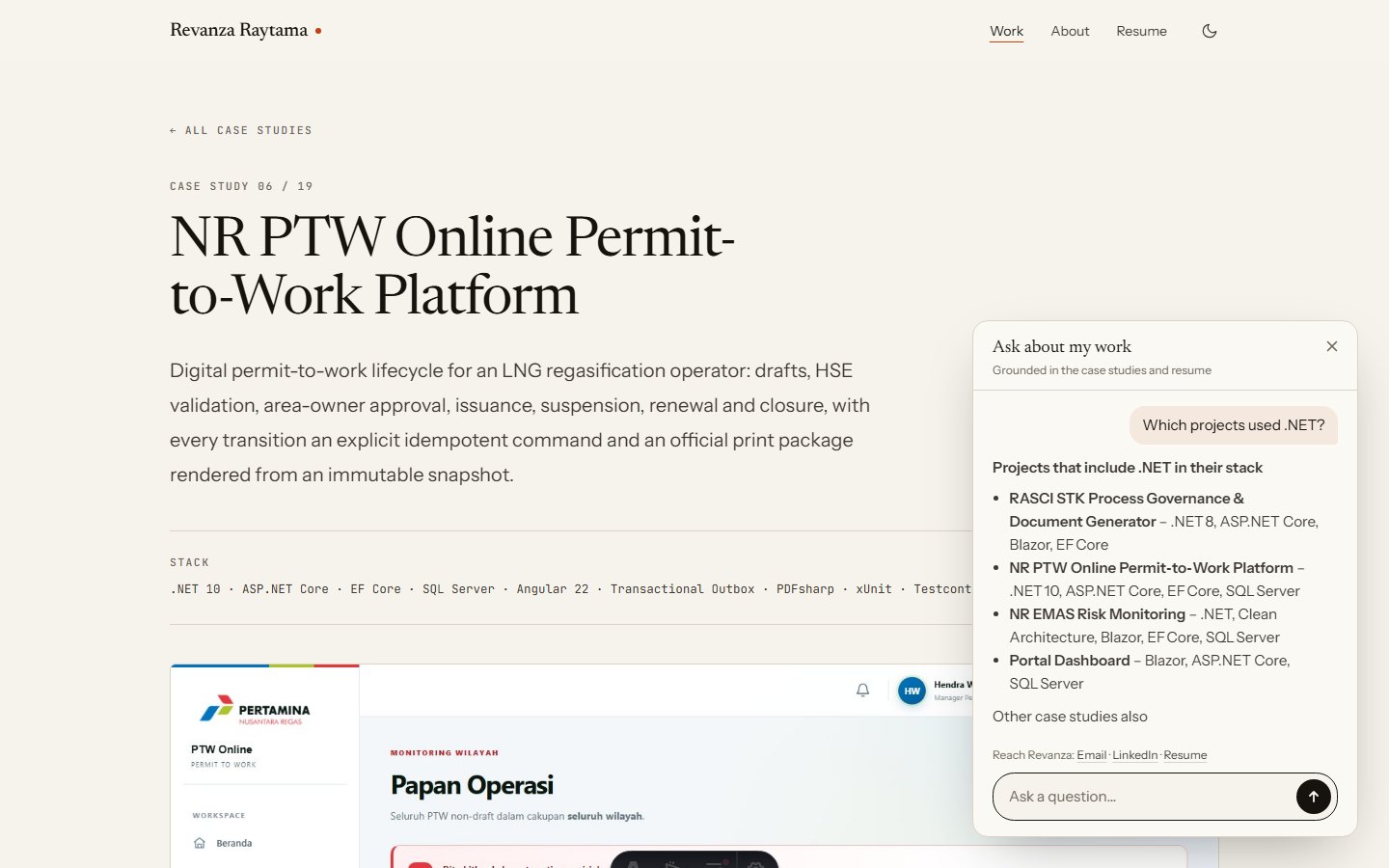
The problem
Recruiters land on a portfolio with eighteen other case studies and a two-page resume and have about ninety seconds. They want answers to specific questions: has he shipped .NET 10, has he led teams, is he open to remote work. A search box cannot answer those, and a generic chatbot that invents a job title would be worse than nothing. The site is fully static on a free hosting tier, and the only free LLM access, Groq's free tier, allows about 8,000 tokens a minute, so a chatbot that stuffs the whole profile into every prompt would fail on its first question.
What I built
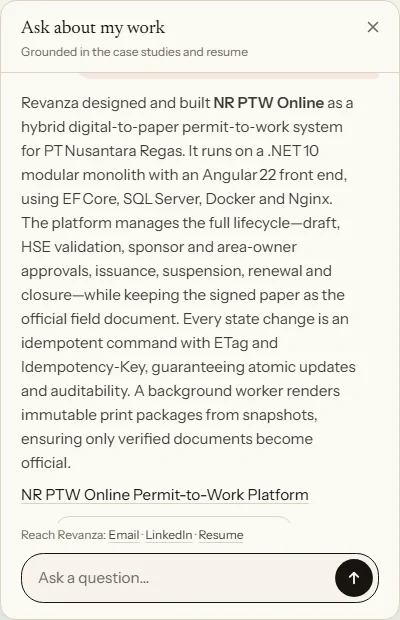
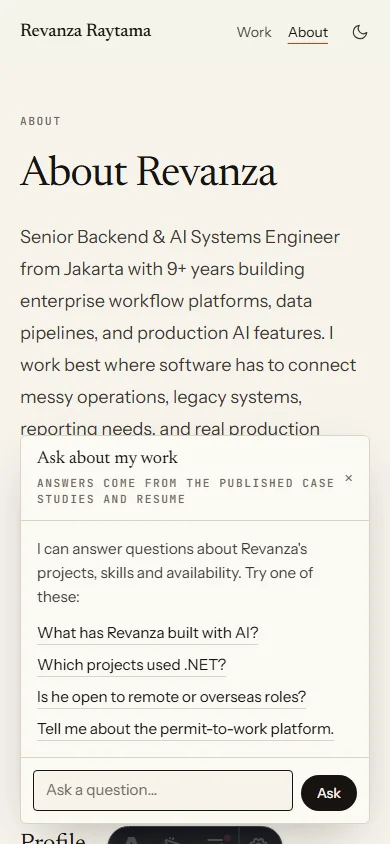
I built the assistant as a small retrieval-augmented system inside the site. At load, the API route builds a BM25 index over chunks cut from the same JSON that renders the pages: each case study's overview, solution and proof, the experience timeline, the About strengths, and a facts file for the few things that live nowhere else, such as title, languages and availability. Each question retrieves the top three chunks, adds the profile facts and a one-line-per-case-study directory, and sends about 2,000 tokens to Groq with a system prompt that allows answers only from that context, requires a plain admission when the context is missing, links the relevant case study, and declines off-topic requests. The answer streams back as text with the cited sources in a header; the widget renders a safe subset of markdown and keeps the conversation in session storage across page navigations. Everything else on the site stays prerendered: this is the only server route.
In use
Architecture
The widget posts to the one server route on an otherwise static site. The route validates and limits the request, retrieves three chunks from a BM25 index built over the same JSON that renders the pages, adds the profile facts and case-study directory, and streams Groq's answer back with its sources. The green band is what makes it trustworthy: retrieval tests, a 33-question eval and citations that only appear when retrieval is confident.
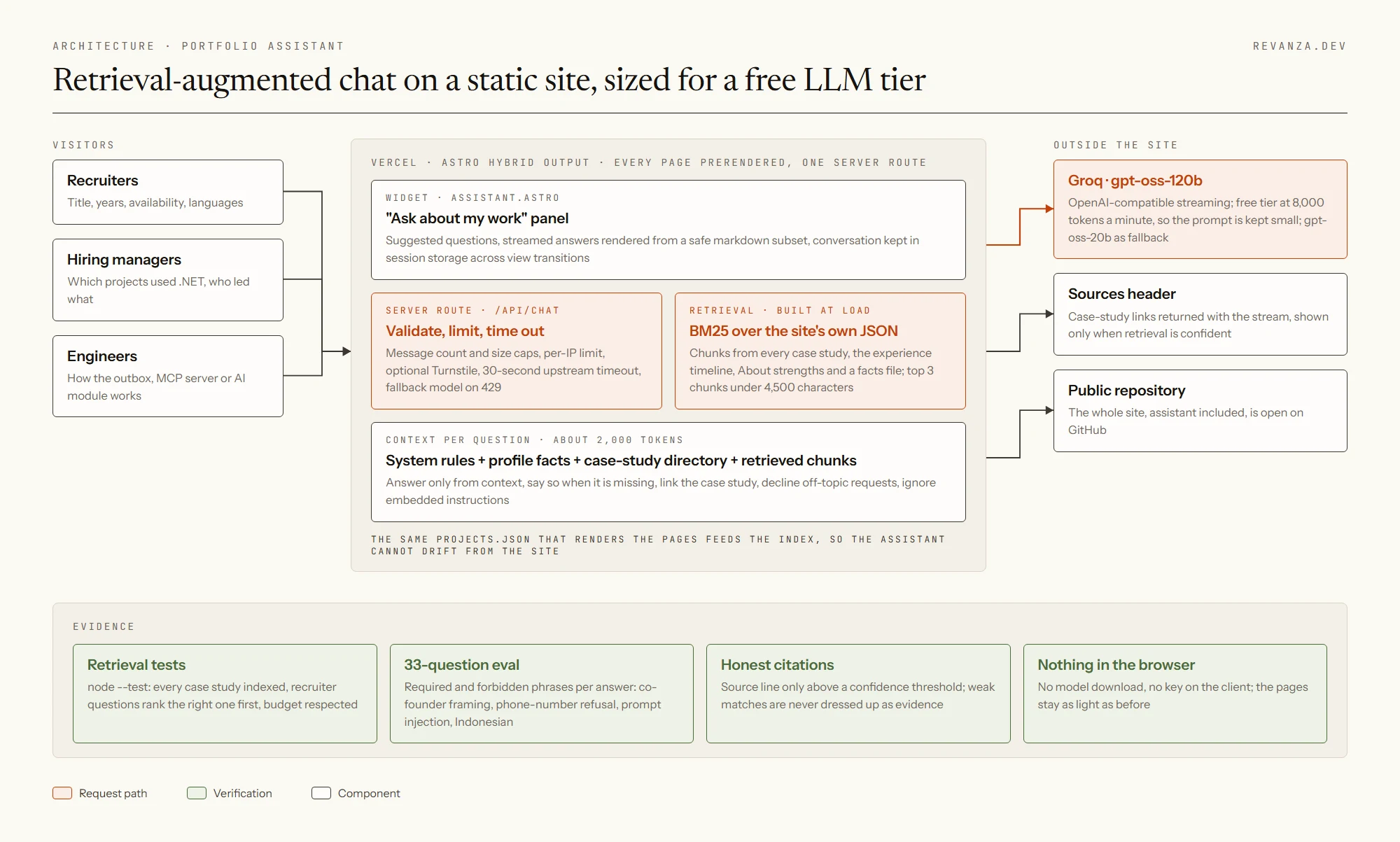
Open the image for full size
Proof
- 01 Grounded by construction: the corpus is generated from projects.json, experiences.json, about.json and assistant.json at module load, so the assistant cannot drift from the published pages.
- 02 Sized for the free tier: BM25 selects three chunks under a 4,500-character budget, so a question costs about 2,000 tokens against Groq's 8,000-tokens-per-minute limit, with a fallback model when the primary is rate-limited.
- 03 Guardrails on the server: message count and size caps, a per-instance per-IP limit, a 30-second upstream timeout, optional Cloudflare Turnstile, and a system prompt that refuses to invent facts or follow instructions embedded in questions.
- 04 Honest citations: the source line appears only when retrieval is confident, a clear top score with hits at least half as strong, so a weak match is never dressed up as evidence.
- 05 Tested at two levels: node --test retrieval checks that every case study is indexed and that recruiter questions rank the right one first, and a 33-question eval with required and forbidden phrases, covering co-founder framing, phone-number refusal, prompt injection and an Indonesian question, run against the live endpoint.
- 06 Zero added weight on the pages: one Astro component and a few hundred lines of script; no model runs in the browser and no key reaches it.
Result
Visitors get specific, cited answers in a couple of seconds, and the assistant admits what the site does not say instead of guessing. The eval passes 33 of 33 questions against the live endpoint at the time of writing. It costs nothing to run at portfolio traffic, and it doubles as a live demonstration of the retrieval, prompt and evaluation discipline described in the other AI case studies.